The book opens with a message from Dale Dougherty, founder of Make Magazine, and I hoped this would be a book that shared one of the disastercommohio missions: getting Makers and Hams working together. The book is more of a microcontroller-book-for-hams, than a ham-book-for-microcontroller-experimenters.
Submitted by N8WDU - Kevin on Tue, 06/26/2012 - 01:15
I'm sure you're familiar with the hello world program. When you're first learning to write code, or taking your first steps into building embedded systems, the documentation and guides typically instruct you to write simple code to print "hello world." Or in the hardware realm, get an LED to blink.
Submitted by N8WDU - Kevin on Tue, 01/10/2012 - 02:30
It was a bit like a high-stakes science fair project. In the early days of the MCC we were often trying to communicate or sell our vision of what it could become. We needed the volunteers to be as excited about the project as we were and carry that up through the chain of command and attract enough interest so they would help fund the project. This meant that we had to use a lot of our own gear to build a working network in the vehicle so they could get a tangible feel for the possibilities.
Submitted by N8WDU - Kevin on Sat, 01/07/2012 - 03:32
You may have seen us refer to an Arduino in other projects. Just what is an Arduino and why should you care?
It's difficult to describe in one sentence, but I've found the Arduino to be the micro-controller solution with the lowest-barriers to entry. They're inexpensive, the development environment is free and has versions for windows, Linux and MacOS, and you only need a USB cable to program them.
Submitted by N8WDU - Kevin on Tue, 11/29/2011 - 02:00
This is an example project entry that directs the reader off-site.
Personally I'm a fan of the arduino platform. I do realize that it's a crutch and real-men us PIC or whatever. I've done simple things with PICAXE, but the turn-around time and approachability of the arduino is unmatched. Some may consider it a toy, but it's a fun toy, and with it I can quickly turn out a physical computing project.
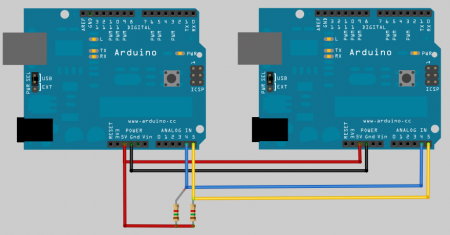
Here is a simple technique using I2C to link two arduinos.