
Deep-Cycle Battery Monitoring Experiment
Motivation
A couple of years ago, I purchased a 12V deep-cycle battery to use in emergencies. I have a little inverter that I could hook up to it and maybe use it to power and appliance or something during the intermittent power outages we have here in the city.
I had this nagging feeling that I wasn't maintaining the battery properly. It's basically been hooked up to an intelligent charger since it was purchased and hasn't been put to use since. So last week (21-NOV-2011) I removed the battery from the charger and about twice a day I've been making DC voltage measurements using a simple digital multimeter.
Shelf-life Experiment
At first I was convinced the battery was a loss. It quickly fell from 13.14V to 12.59V in about 24 hours. After a week later it's still hovering at 12.53V.
I intend to let this go another 7 days, and then throw a load on it to see how well it stands up and what I can expect out of it.
UPDATE 07-DEC-2011:
After another week, I've pulled together the numbers and plotted them out for you.
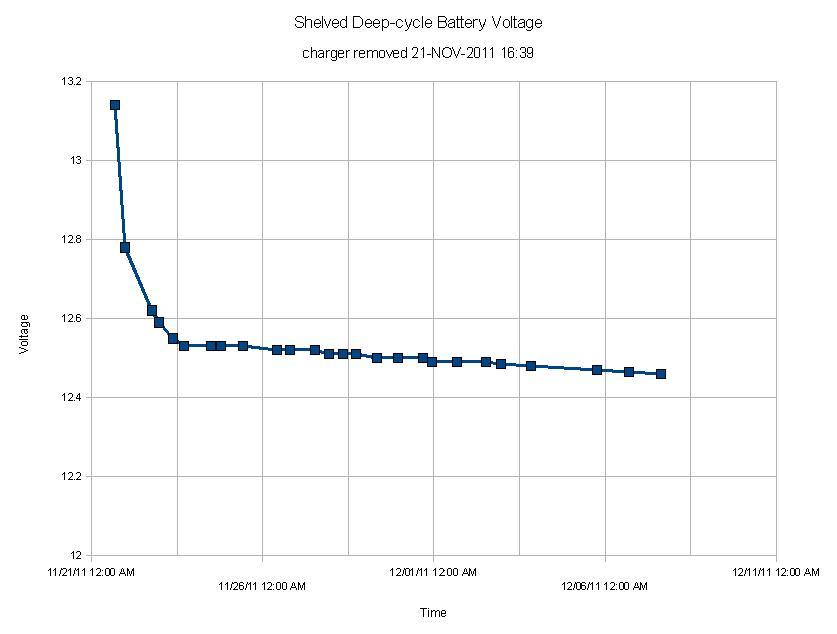
Shelf-life results
It appears that the intelligent charger was worth the investment. After over two weeks off of the charger, Battery voltage is currently at 12.46V. But is that enough to be useful?
Usability Experiment
In order to answer that question, I conceived of a simple use-case scenario. I have a laptop dedicated to response operations and a little 300W inverter. Could I run the laptop via the inverter from this battery? I pulled the laptop battery out to make this a more of a test of the deep-cycle as opposed to the laptop battery. The plan was to instrument the set-up, see if it actually worked, take some measurements as we went, and let it run for 45 minutes or so and see how the battery fared after that.
Instrumentation
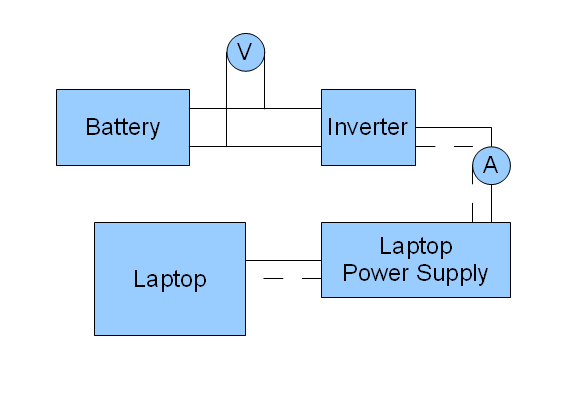
For this exercise, I used to multimeters. The first is a standard digital multimeter which I've been using to measure voltage during the shelf-life experiment, it will be used to check DC voltage periodically. The second is digital clamp meter. It's purpose is to measure Amps between the inverter and the laptop power-converter.
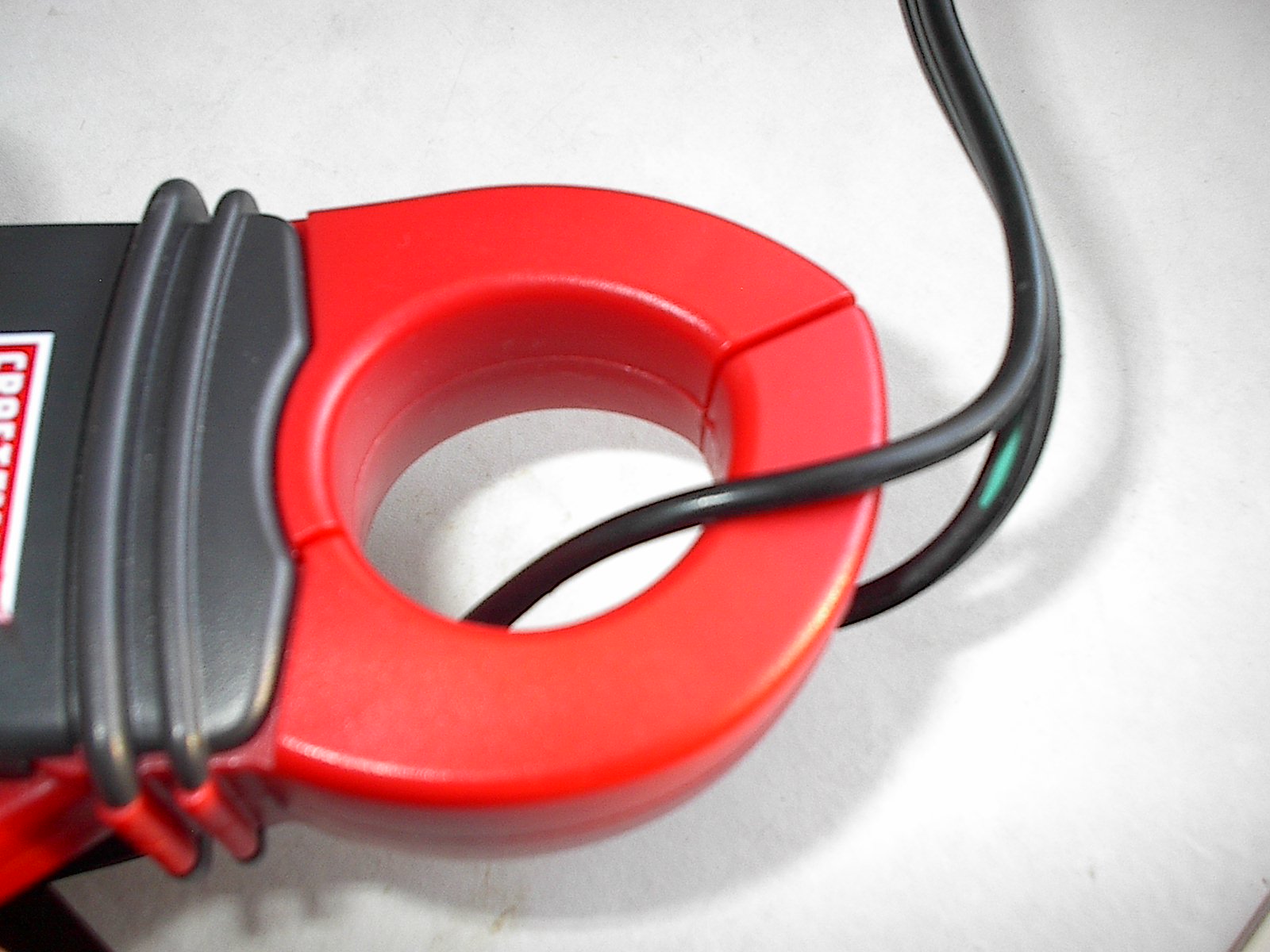
To allow the clamp meter to take AC measurements I had to isolate one of the feeds to the laptop power supply. Fortunately, the design of the cable made it easy to safely cut along the 3-conductor cable and pull one away from the others. The clamp went around this line to take measurements.
With the clamp meter in place, and everything plugged in, I started to take measurements at 22:55 08-DEC-2011.
Measurements
Before I hooked up anything to the battery, it was reading 12.455 V (well, it was bouncing between 12.46 and 12.45.) After hooking everything up and powered-off, it had the same reading (so there appears to be no phantom load effect from the inverter.) Once we switch it on voltage dropped to 12.32V and there was .055A on the feed to the laptop power supply (so it draws a load whether the laptop is on or not.)
Once the laptop was powered on, it was pulling 0.36A during boot-up, voltage measured at the inverter input dropped to 11.895V. 15 minutes into the experiment it was down to 11.8V.
After 45 minutes, I shut the laptop down. With everything plugged in and the laptop off, 0.05A remained trickling to the laptop power supply and 12.19V were being fed into the inverter. After everything was disconnected, the battery read 12.385V.
Checking my calculations
The laptop power supply output is rated 20V 4500mA. So that's 20V * 4.5A = 90 watts expected maximum output. I was reading .39A on my meter so at 110VAC that's around 42.9W, 46.8W if it was generating 120VAC.
Aftermath?
After 3 days of rest, the battery reads 12.46V at 10:11 11-DEC-2011. So I guess I wasn't pushing the battery that hard in the experiment.
- Log in to post comments