Submitted by N8WDU - Kevin on Fri, 12/04/2015 - 02:02
If you felt a little let down by the simple act of using a GUI like SDRSharp or GQRX to listen to commercial FM and wanted a little more challenge, then give GNU Radio a try. You will learn a lot about Digital Signal Processing and Software Defined Radio in the process. Things are going to get a little theoretical at first.
Submitted by N8WDU - Kevin on Sun, 11/29/2015 - 20:11
Between Commercial FM and the 2-Meter Amateur band is the air band used by commercial aviation for air traffic control and navigation. I picked up a sectional aeronautical chart which has helpful information on what channels are used by which airfield and the location of radio navigation devices. In areas where there is not an identified channel on the chart, you may find traffic on 121.5 (the emergency channel,) 122.2, 234.0 and 255.4 MHz. Also of note, on one of these charts you can find the highest points in the area either geographically, or towers or buildings.
Submitted by N8WDU - Kevin on Wed, 11/18/2015 - 03:09
APRS is still one of my favourite modes with its squawky packets bursting, and your map slowly filling up with icons. I always felt it had a huge potential for coordinating events. It felt like a natural fit for EMCOMM.
Submitted by N8WDU - Kevin on Sun, 11/15/2015 - 23:34
Requirements:Basic receiver software and a single dongle. Capabilities:Easily determine what commercial FM broadcast you are receiving, connect basic receiver software to an auxiliary program, add a plugin to SDRSharp.
Radio Data System (RDS) is present is some FM commercial broadcasts. It's what displays the station identification or sound name on your modern car radio. There can be more to it than that though.
Submitted by N8WDU - Kevin on Sun, 11/15/2015 - 19:47
Requirements:Single Dongle. Basic audio client, windows or Linux. Capability:Reception of VHF 6-M Ham Band, regional distances, longer when conditions permit.
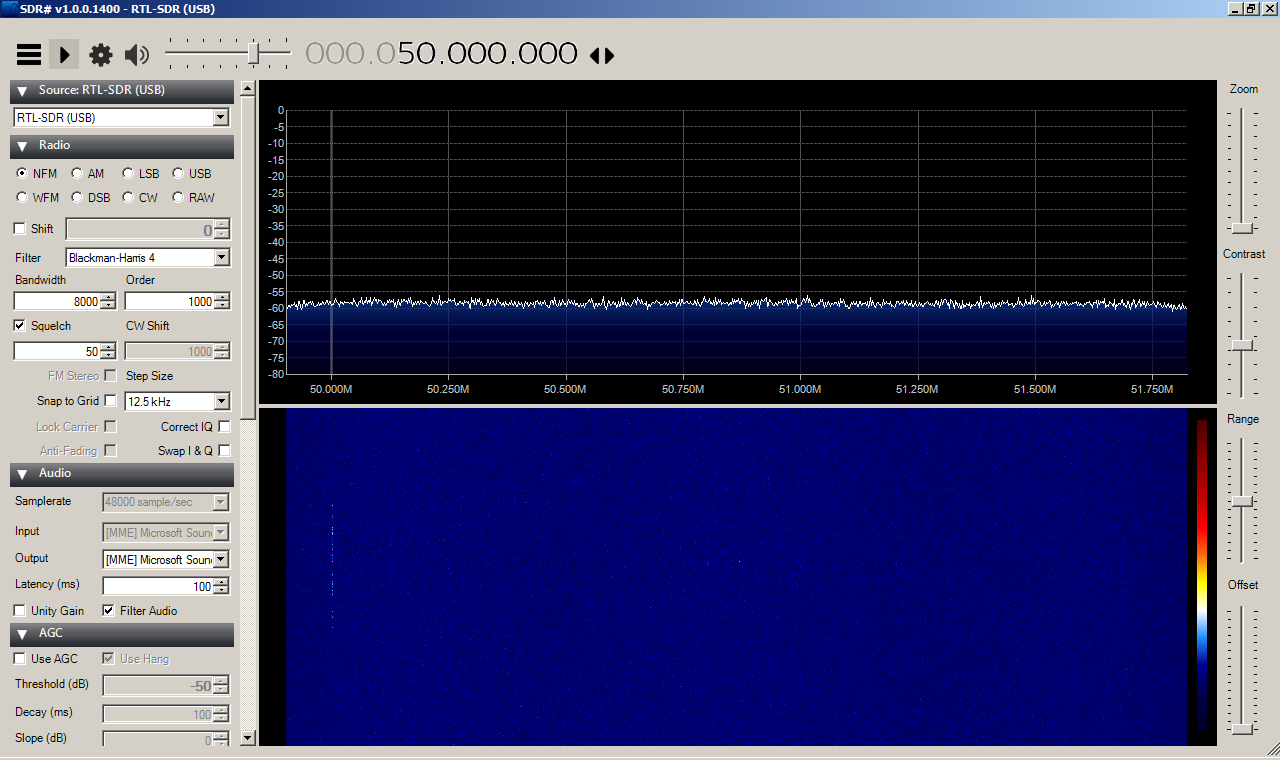
Tune down to the advertised limit of some of the RTL-SDR dongles to the 6-Meter band, 50 to 54 MHz.
I'm using a simple discone antenna which is good of wideband reception but not always ideal for pulling in some signals. When I tune down to 50 MHz I get a disappointing waterfall like this: